
A passionate testimony from a Qigong practitioner and an overview of the Tai Ji Men case.
Lee Li-Chun*
*A paper presented at the 8th Annual Conference of the East Asian Society for the Scientific Study of Religion (EASSSR), Kaohsiung, Taiwan, July 1, 2026.
An article already published in Bitter Winter on July 3rd, 2026.
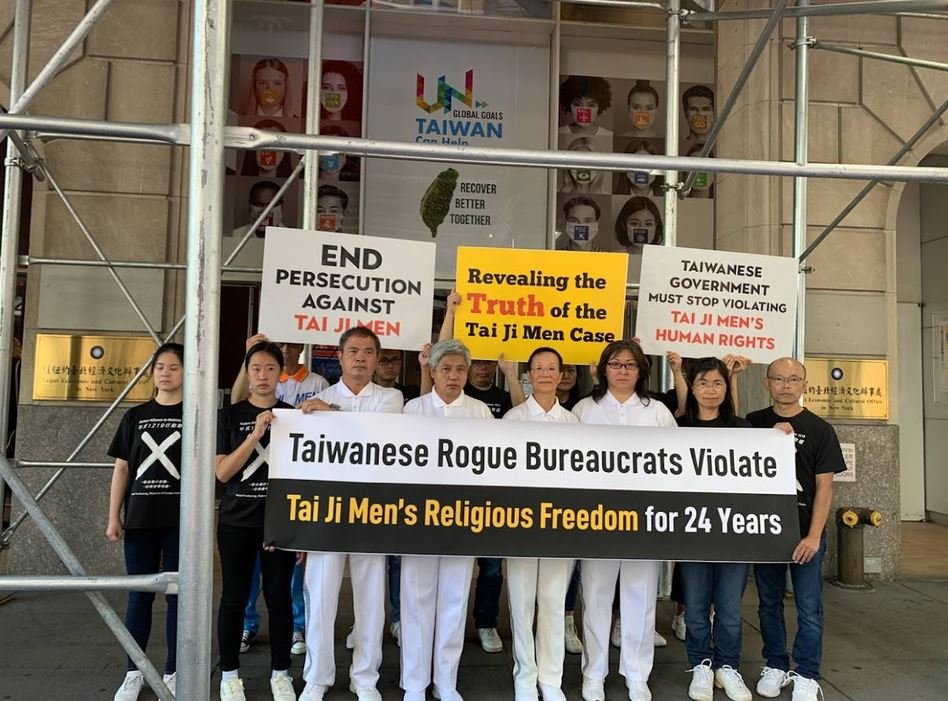
My name is Lee Li-Chun, a retired high school English teacher. I will present an emic view of the Tai Ji Men case, as I am myself a dizi (disciple). To explain my perspective, I need to tell you a bit about myself first. Over 30 years ago, my husband was diagnosed with ankylosing spondylitis. Introduced by a colleague, he became a dizi (disciple) of Tai Ji Men and began practicing Qigong. Soon after, he no longer needed medication, and at his six‑month follow‑up appointments, his inflammation index was zero. I also became a dizi of Tai Ji Men at that time. After retiring, I devoted myself to the global promotion of Tai Ji Men, which I believe has helped me cultivate emotional balance, learn to cooperate with others, and travel to various countries to share what we describe as a culture of conscience, love, and peace, allowing me to live a healthy, happy, and meaningful retirement.
I am honored to have the opportunity to participate in the 8th Annual Conference of the East Asian Society for the Scientific Study of Religion (EASSSR) and to discuss this topic based on my personal experience and observations: “Religious Persecution Harms People’s Freedom of Religious Belief: A Case Study of the Tai Ji Men Human Rights Case.”
As is well known, Taiwan is a democratic country governed by the rule of law. Sixteen years ago, it incorporated the two United Nations human rights covenants into its domestic law. This represents the Taiwanese government’s declaration to the world of its commitment to protecting human rights, freedom of belief, and the property rights of the Taiwanese people. The government should do everything in its power to safeguard the rights that the people should enjoy. Unfortunately, this is not always the case.
I will now present a summary of the Tai Ji Men case.
Tai Ji Men is a menpai (similar to a school) for Qigong, self-cultivation, and martial arts. On December 19, 1996, Prosecutor Hou Kuan‑jen, accompanied by hundreds of fully armed police and investigators, simultaneously searched 19 Tai Ji Men academies and the residences of some Tai Ji Men dizi across the country, accusing the menpai of fraud and tax evasion. However, some of the search warrants he issued contained incorrect addresses, and more than 10 addresses were marked “related premises,” allowing the police and investigators to search, with impunity, even private residences unrelated to the case. The Shifu (Grand Master) of Tai Ji Men, his wife, and two dizi were detained.
The next day, Prosecutor Hou searched for evidence at four Tai Ji Men academies in Da’an, Nangang, Shulin, and Kaohsiung. This practice of “shooting the target before drawing the line” violates procedural rules. He indicted first, then searched for evidence, then interrogated. Even more embarrassingly, his indictment even charged Tai Ji Men with “raising goblins.” Hou publicly claimed that, indeed, a “peach wood sword” found at the Nangang Academy was evidence of “raising goblins.” That peach wood sword was merely a gift from a dizi to her Shifu (Grand Master); moreover, peach wood swords are folk objects used to ward off evil spirits and have no connection to the accusation. “Raising goblins” is not part of any Tai Ji Men practice.
Kenneth Jacobsen, an American human rights lawyer and professor of law at Temple University in Philadelphia, who has been researching the Tai Ji Men case for several years, pointed out in an article that in a civilized society, prosecutors accusing someone of raising goblins would be questioned for their mental soundness.

After a rigorous 10-year-3-month sequence of court cases, the Supreme Court finally ruled on July 13, 2007, that the Tai Ji Men defendants were innocent and that the menpai was tax-exempt. The court determined that “gifts given by dizi to their Shifu as a sign of respect are tax‑exempt under Article 4, Paragraph 17 of the Income Tax Act.” All the defendants who had been detained received state compensation for their wrongful imprisonment.
However, the National Taxation Bureau still used the original, ill-founded indictment to issue tax bills, disregarding the court’s ruling—a fundamental error and an international embarrassment. Finally, it corrected all the tax bills to zero, except for the 1992 bill. Nothing different had occurred in 1992 compared to the other years, but the Bureau used a technicality to maintain that specific bill. Based on the unpaid 1992 bill, land that Tai Ji Men regarded as sacred was seized, unsuccessfully auctioned off, and nationalized in 2020, sparking widespread protests.
A key issue is that National Taxation Bureau auditors receive tax incentives that have already been paid out. Admitting mistakes would require the return of these incentives.
The Tai Ji Men case has dragged on for 30 years without genuine redress. Its study has, after continuous research and discussion by experts and scholars both domestically and internationally, led to the following conclusions:
1. The 1992 tax penalty was clearly a wrongful judgment, invalid from the outset, and should be revoked according to Article 117 of the Administrative Procedure Act.
2. Tai Ji Men is an ancient menpai of Qigong and martial arts practice. The behavior of both Shifu and dizi in the face of injustice has demonstrated their peaceful character and sound moral values.
3. The Tai Ji Men Shifu-dizi culture is part of a venerable Chinese tradition and includes the offering of gifts in the so-called “red envelopes.” These are gifts rather than (as the prosecutor argued) tuition fees for a cram school. As gifts, they are not subject to taxation.
In late May 2023, I had the opportunity to travel with three members of the Association of World Citizens (AWC) of Taiwan to Prague, Czech Republic, to participate in the annual meeting of the World Taxpayers Association (WTA). We shared the Tai Ji Men tax case with about 60 leading experts from tax reform groups in more than 20 countries, exchanging practical experience. The former WTA president, Staffan Wennberg, stated that the tax incentive system is completely flawed. Tax authorities should prioritize serving taxpayers and avoiding unnecessary conflicts. Bjorn Tarras‑Wahlberg, founder and secretary‑general of the WTA and president of the Asia‑Pacific Taxpayers Alliance, went even further, stating that tax incentive systems need to be abolished entirely.

In conclusion, I return to my personal experience. People say, “Only the wearer knows where the shoe pinches.” Or, “Only the person drinking the water knows whether it is hot or cold.” I have been in Tai Ji Men for over 30 years. After retiring from my teaching position 11 years ago, I went to the Kaohsiung Academy almost every day and tried to participate in every activity. The Tai Ji Men Goodwill and Cultural Delegation has visited 123 countries at the dizi’s own expense, promoting the concepts of conscience, love, and peace. They have also brought Tai Ji culture to various parts of the world, allowing international audiences to encounter aspects of Taiwanese culture. Many dizi willingly follow these ideals and engage in these activities across different communities. The Taiwanese government should recognize such civic engagement.
I have also noted that Tai Ji Men is not the only group affected by a dysfunctional tax system; many taxpayers suffer as well. Several academics and politicians in Taiwan have made similar comments. Professor Wu Jingqin of the Department of Law at Aletheia University once said, “The Tai Ji Men case is like a mirror, reflecting the dark side of our country’s judiciary and tax system.” Lawyer and former legislator Huang Wenling stated, “In the Legislative Yuan, I discovered that the most important reason for the Tai Ji Men case was that tax officials received bonuses. I advocated for their removal but encountered great resistance.” Former Chairman of the Chinese Association for Human Rights, lawyer Lin Tiancai, also stated, “I thank Tai Ji Men for their insistence on getting to the bottom of their unjust case and for their unwavering pursuit of right and wrong. They have not only paved a broad path for themselves but also illuminated a brighter future for taxpayers’ rights.”
In 2017, the InterNations platform conducted an online survey on education, security, and infrastructure across 191 countries and ultimately selected the “21 Most Livable Countries.” Taiwan not only made the list but also ranked first. As a Taiwanese, I am happy about this result. However, I respectfully suggest that, had questions about the tax system been included, the result would have been less favorable for Taiwan. Many businesses and professionals have indeed left Taiwan, citing its difficult and unfriendly tax system as a reason.
If the Tai Ji Men tax case and many other tax cases are overturned, allowing Taiwanese people’s tax rights to improve and encouraging talented individuals to stay, then, with the advantage of being ranked first among truly livable countries, economic growth will be just around the corner, and Taiwan can be truly transformed into a peaceful and prosperous society.