
The Tai Ji Men case exposes systemic flaws in which fabricated evidence and unlawful tax bills went unchallenged for 30 years.
by Alessandro Amicarelli
An article already published in Bitter Winter on April 17th, 2026.
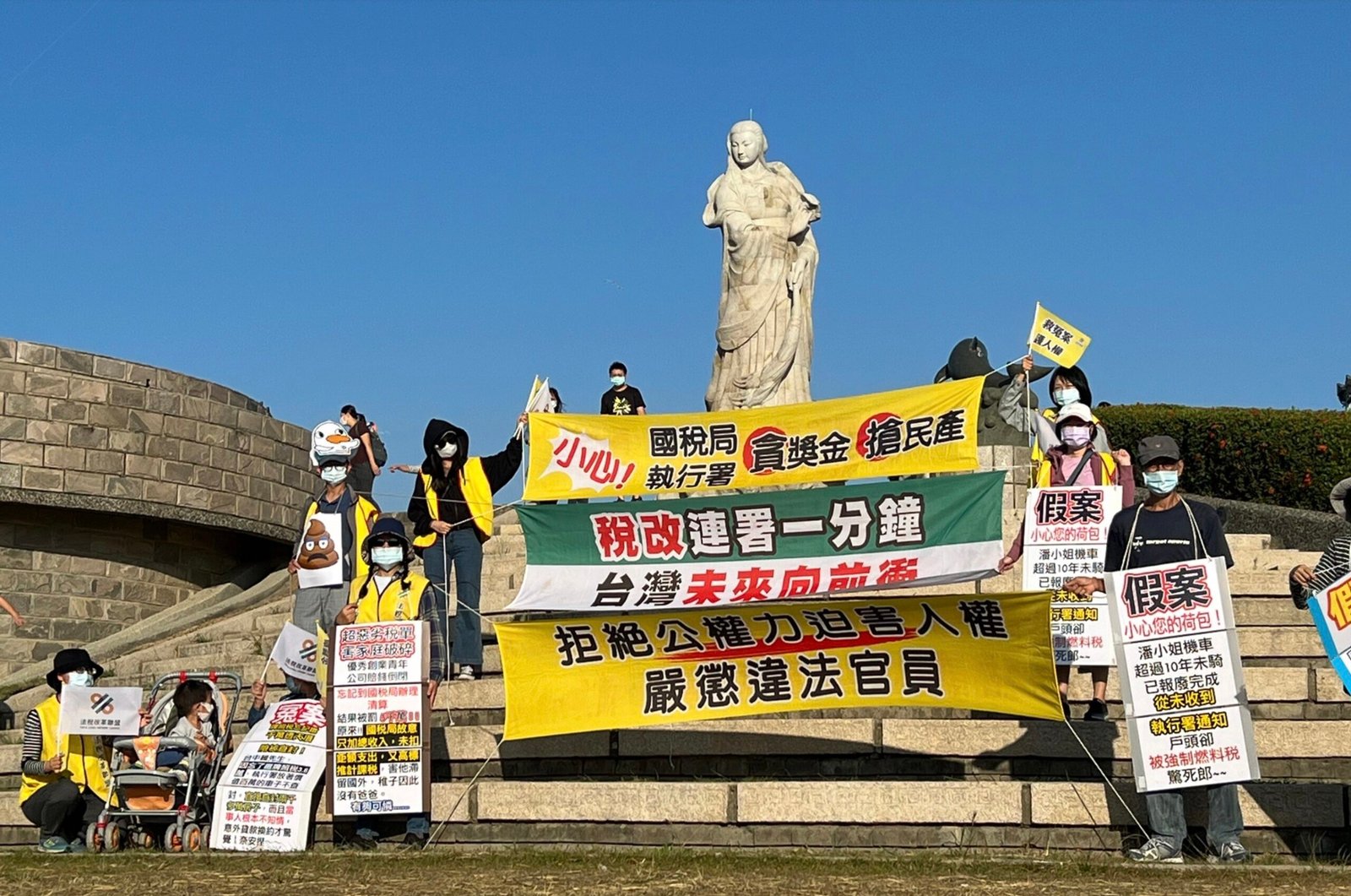
Before Taiwan’s 228 Peace Memorial Day, Taiwan’s Democratic Progressive Party (DPP), which is currently in power, posted on social media that the scars of history live not only in the hearts of the victims’ families but also in the public sphere. Remembering the truth, clarifying responsibility, and remaining vigilant to avoid repeating past mistakes are duties shared by all Taiwanese—regardless of political party, ethnicity, or generation, the DPP wrote.
On February 28, 1980, the Lin family murders occurred (the family members of then–Provincial Assembly member Lin Yi-hsiung were victims). It remains one of the most well-known unsolved political cases of Taiwan’s martial law era. Tien Chiu-chin (now a Control Yuan member), who was serving as Lin Yi-hsiung’s secretary at the time, was the first friend to arrive at the scene of the tragedy. She said emotionally in an interview ahead of this year’s 228 Peace Memorial Day. Revisiting this history, she said, is not meant to incite hatred but to help society understand the circumstances and context of that time. “This is why human rights education is so important!”
Tien (who served as a legislator from 2005 to 2016) later learned of another injustice—this time in Taiwan’s post-authoritarian era: the Tai Ji Men case. She described it as a scandal in which tax law was used to entangle a spiritual movement “like vines until they died.” As a legislator, she repeatedly questioned the authorities and publicly supported Tai Ji Men. “The National Taxation Bureau obsessively pursued a case that had already been ruled lawful and without issue by the judiciary, the Control Yuan, and the Supreme Administrative Court,” she said. “Illegal tax bills were revived again and again for more than a decade. Taxpayer rights were completely eradicated. When a civil society group of more than ten thousand people is treated this way, ordinary citizens are left speechless and helpless.”
Scholars argue that the Tai Ji Men case is a mirror reflecting the true state of the rule of law in Taiwan. Several of them spoke at the 2026 Peace Memorial Day forum, “Law and Tax 228: A Glimpse into the Truth,” revisiting the Tai Ji Men case.
Professor Chen Chih-lung, Chairman of the Taiwan Association for Financial and Economic Criminal Law Research, notes that the case is not merely a tax dispute but a fabricated case of “invented charges and tax evasion”—a “super-absurd” tax case. He urges the Minister of Finance to uphold systemic justice and to “exonerate and correct the wrongs,” so that Taiwan’s fiscal and tax system can return to the right track.
Chen points out that the six years of “tax bill” in the Tai Ji Men case were abnormal because they were not generated through tax audits by grassroots tax officials. Instead, they were copied directly from information transferred by the Investigation Bureau. In an official letter dated March 7, 2000, the National Taxation Bureau admitted that “the content, nature, and amount originally approved by this Bureau were based on the information and calculations provided by your office.” This official letter is a crucial piece of evidence. It proves that no tax investigation ever took place.
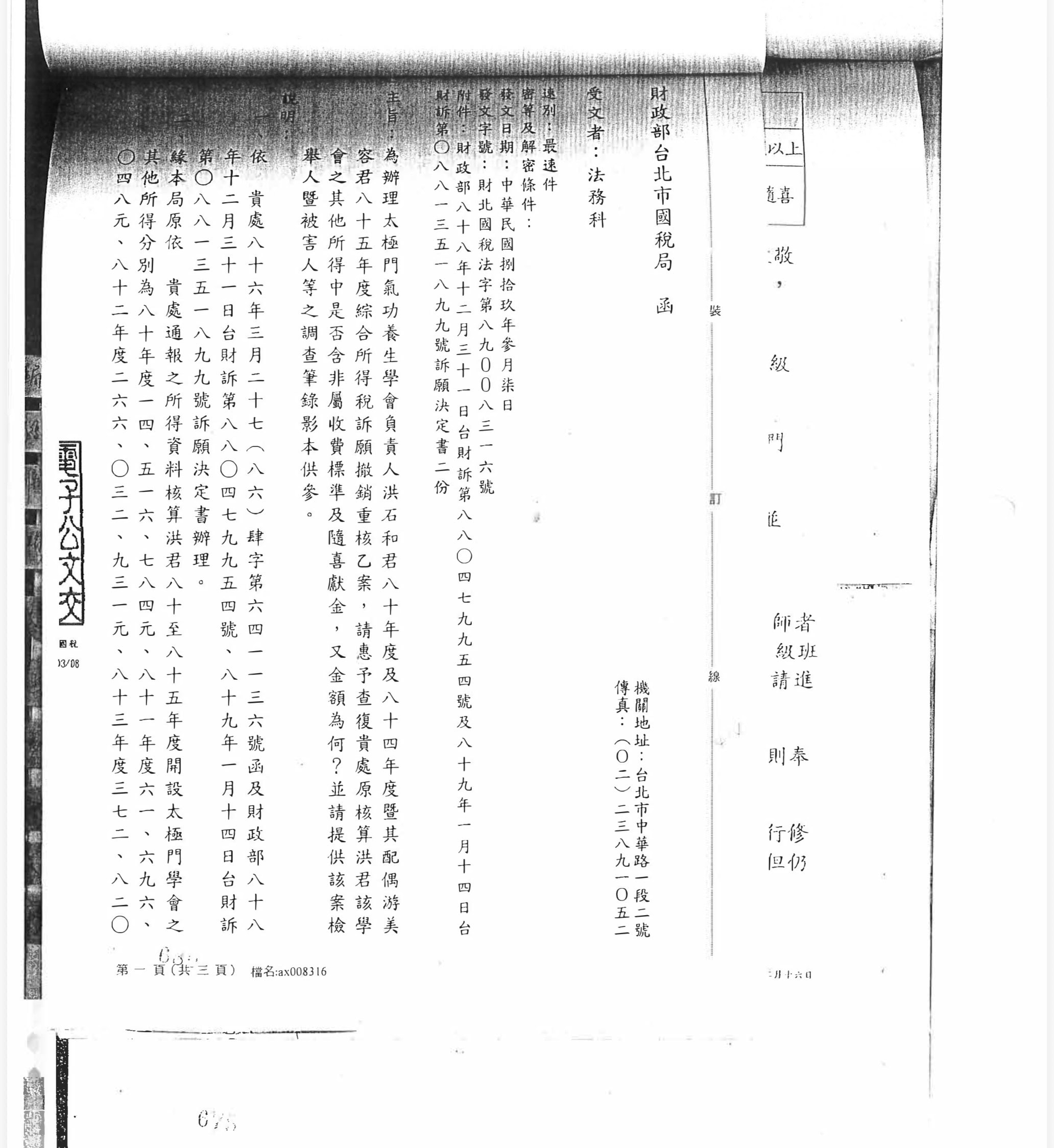
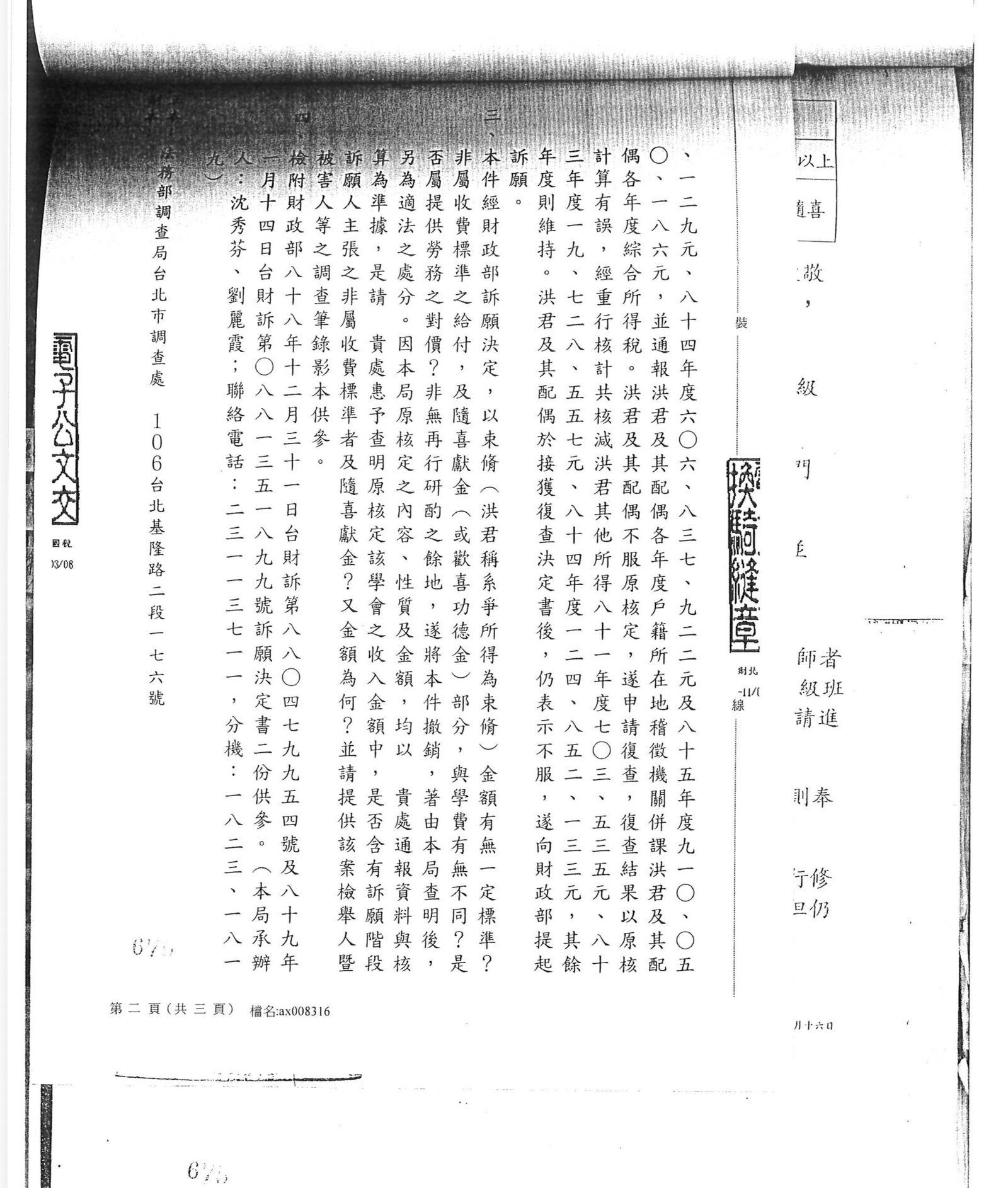
Article 3 of the Tax Collection Act clearly states that tax agencies must collect taxes at all levels of government. As early as 1981, the Ministry of Finance clarified that investigators under the Investigation Bureau are not tax collection personnel. Yet in the Tai Ji Men case, the Taipei City Investigation Office effectively became the National Taxation Bureau’s superior, abandoning its authority and simply copying the Investigation Bureau’s data.
Professor Huang Chun-chieh of National Chung Cheng University notes that the Bureau’s own letter proves it failed to fulfill its legal obligation to conduct an independent investigation before issuing tax bills. This violates Article 43 of the Administrative Procedure Act, which requires agencies to consider all relevant facts and evidence, judge the truth according to reason and experience, and inform parties of the basis for their decisions. The Bureau’s actions ignored due process and violated the basic requirements of a state governed by the rule of law.
Professor Ge Ke-chang of Soochow University adds that tax law is part of the Constitution, and its due process requirements are far stricter than those of ordinary administrative law. Invalid administrative actions, he notes, are invalid from the beginning and may be challenged at any time. The Tai Ji Men case, he argues, is a textbook example of an invalid administrative penalty.
The Tai Ji Men tax case was fabricated from the outset. It originated with Prosecutor Hou Kuan-jen’s illegal prosecution and his transfer of the case to the National Taxation Bureau for tax assessment. The Bureau failed to act in accordance with the law, conducted no factual investigation, and copied the inflated figures prepared by the Investigation Bureau. This was both a “qualitative fabrication” (inventing the nature of the income) and a “quantitative fabrication” (inventing the amounts). The Control Yuan’s 2009 investigation identified seven major violations by the Bureau, including failure to verify facts, investigate, or assess properly, and failure to clarify the nature of the income.
In 2021, tax collector Shih Yueh-sheng, nearing the end of his battle with cancer, revealed the truth, stating that Hou Kuan-jen had manipulated the Tai Ji Men case and that the prosecutor’s summoning him to testify at the time of the incident was just a travesty.
The contradictions were glaring. In the criminal indictment, the same funds were classified simultaneously as fraudulent proceeds (to be confiscated) and as tuition revenue (to be taxed). The Bureau should have waited for the criminal court’s judgment to determine the nature of the income. Instead, it issued tax bills based solely on the indictment.
Accountant Li Yingxin, a lifelong advocate for taxpayer rights, noted that in the case of former President Chen Shu-bian, the Bureau correctly distinguished between proceeds of corruption (which must be confiscated and are not taxable) and personal funds (which may be taxable). If the proceeds were the former President Chen’s personal election surplus transferred to his son, Chen Chih-chung, they would be subject to gift tax under the law. Therefore, it was necessary to wait for the judicial verdict to determine the nature of the funds before deciding whether to tax them.
But in the Tai Ji Men case, the Bureau ignored this principle, issued tax bills before the criminal verdict was reached, and failed to investigate the nature of the funds. The tax bills were flawed and invalid from the beginning.
Under Article 83 of the Income Tax Act, taxpayers may be asked to submit accounting books and vouchers. If they fail to do so, the Bureau may estimate income based on industry standards. But in the Tai Ji Men case, the Bureau never notified the taxpayer and directly estimated income, thereby violating statutory procedure.
The Bureau also used the indirect proof method without obtaining the required approval from the Ministry of Finance, thereby violating Article 83-1. This is a major defect that cannot be remedied, rendering the tax decisions invalid under Article 111 of the Administrative Procedure Act.
Experts, including accountant Wang Ming-yi and Professor Huang Chun-chieh, emphasize that indirect proof must be used cautiously and only with the Ministry’s approval. Without such approval, the decision is invalid.
Former judge Yuan Congzhen stated that the Bureau’s tax bills were illegal. Former Deputy Director of the Taxation Administration Xu Chun’an publicly acknowledged that, without the Ministry’s approval, the Bureau could not rectify the case and would have to admit defeat. The Tai Ji Men case, he said, should be overturned on the grounds of conscience and justice.
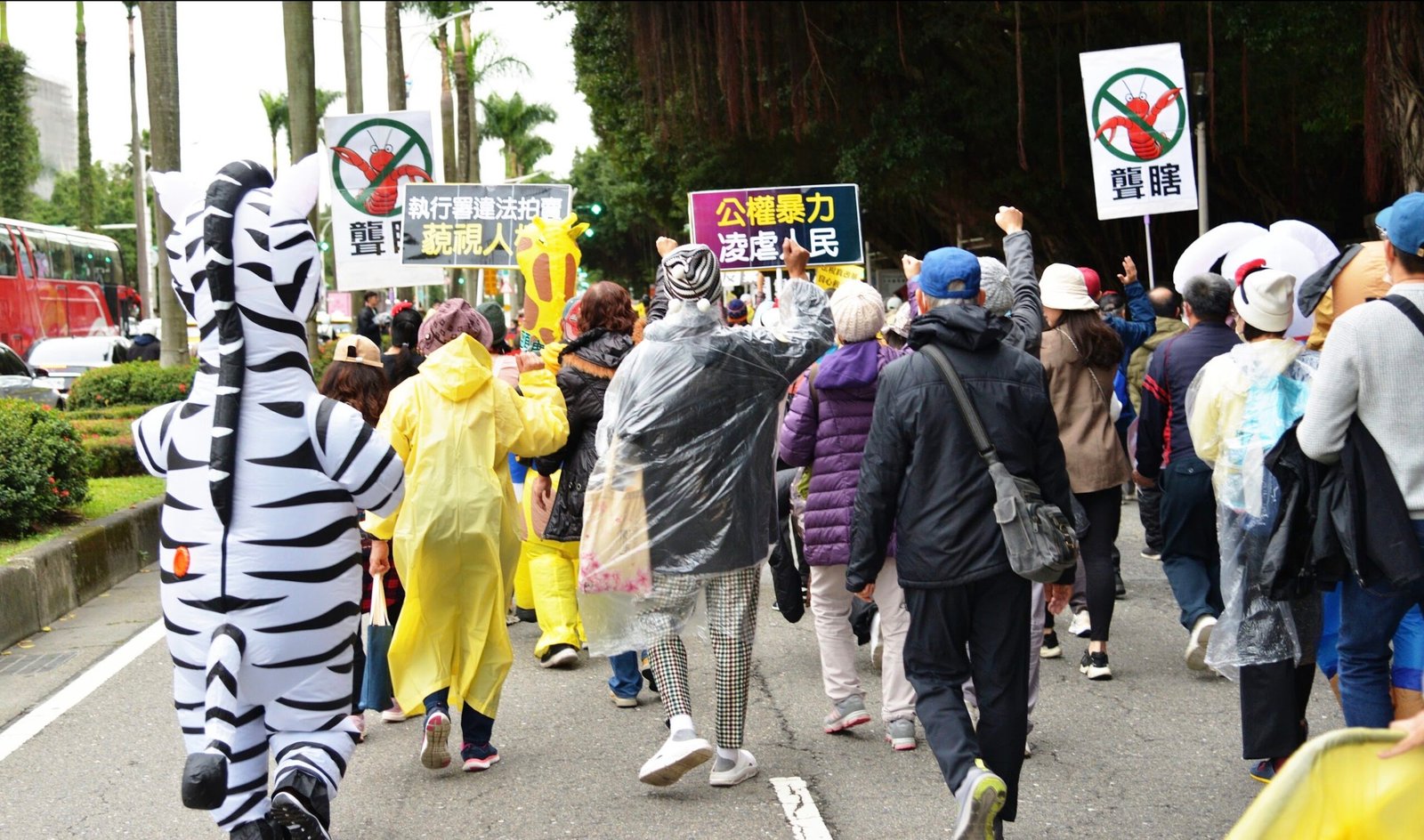
The case originated from Prosecutor Hou Kuan-jen’s illegal investigation and prosecution. In 2002, the Control Yuan identified eight major violations by Hou and referred him for disciplinary action. Hou admitted he had not conducted an investigation. Legally, an indictment is merely an allegation and cannot be used as a basis for taxation. Yet the Bureau treated it as conclusive evidence.
In 2007, the Supreme Court ruled that Tai Ji Men had no tax obligations and had not violated the Tax Collection Act. The Court confirmed that disciples’ gifts to their master were gifts, not tuition, and therefore not taxable.
Former Control Yuan member Chien Lin-hui-chun recalled that during her 2009 investigation, she identified seven areas requiring correction. Each time, the Bureau admitted error. In 2011, she told the Minister of Finance, “This case is clearly wrong; it should be closed.” Yet it continues to this day.
Former judges and scholars—including Judge Wen Yao-yuan and Professor Hu Boyan—have repeatedly emphasized that indictments and investigative documents are not admissible evidence and cannot serve as the basis for taxation. Yet the Bureau relied exclusively on them.
Taiwan’s first presidential election in 1996 marked the beginning of democracy and freedom. Yet remnants of authoritarianism lingered, disguised as crackdowns on “cults,” causing collateral damage to groups like Tai Ji Men. Under the guise of “legal procedures” and “taxation,” administrative authorities carried out a double persecution.
The truth is now clear. Tax officials conducted no investigation. They copied data from the Investigation Bureau. They used indirect proof without the Ministry of Finance’s approval. They issued six inflated tax bills and imposed heavy fines.
The truth is clear: Tai Ji Men is a qigong and martial arts school, not a cram school. The Ministry of Education explicitly confirmed this. Since it is not a cram school, there is no tuition—and no basis for taxation.
The truth is clear: The National Taxation Bureau acknowledged in 2012 and 2013 that Tai Ji Men was not a cram school, yet failed to revoke the illegal penalties, leaving Tai Ji Men trapped in a procedural black hole.
As “Bitter Winter”’s editor-in-chief, Massimo Introvigne, has noted, the unresolved Tai Ji Men case is a painful reminder of how authoritarian residues persist. Tai Ji Men transformed suffering into peaceful resistance, turning injustice into a global movement of conscience. The 2026 Peace Memorial Day forum, “Law and Tax 228: A Glimpse into the Truth,” brought together experts and scholars to analyze the case and call for its exoneration—so that Taiwan may finally free itself from the lingering shadows of martial law.