
A long lineage of Chinese religious and philosophical reflection on the “five poisons may illuminate Tai Ji Men’s struggle for conscience and justice.
Rosita Šorytė*
*Introduction to the plenary session “Conflicts, Spirituality, and the Priority of Conscience: Taiwan’s Tai Ji Men Case in Comparative Perspective” at the Fourth World Conference for Religious Dialogue and Cooperation, Skopje, North Macedonia, June 24, 2026.
An article already published in Bitter Winter on June 24th, 2026.

This session invites us to examine the Tai Ji Men case in Taiwan through a multidimensional lens to explore broader questions of conscience, state power, and contemporary forms of religious conflict. The six papers we will hear today approach the case from complementary disciplinary angles—legal anthropology, comparative religion, political theory, and the study of new religious movements—yet they converge on a shared concern: how conscience functions both as an inner moral compass and as a principle capable of reshaping institutional life.
The session begins by introducing Tai Ji Men’s central teaching of the “priority of conscience.” This principle, articulated by the movement’s Shifu, or Grand Master, Dr. Hong Tao‑Tze, emphasizes moral clarity, self‑cultivation, and peaceful conflict resolution. It is not merely an ethical aspiration but a hermeneutic key for understanding the movement’s long‑standing legal struggle in Taiwan. As many of you know, the Tai Ji Men case has become emblematic of the tensions that can arise when administrative systems confront spiritual communities that do not fit neatly into pre‑existing legal categories. The case thus raises fundamental questions about the boundaries of freedom of religion or belief, taxpayers’ rights, the state’s responsibilities, and the rights of minority spiritual groups in contemporary Taiwan.
The papers that follow will deepen this inquiry. One examines how categorical misfit within bureaucratic systems can generate institutional violence against spiritual communities. Another situates Tai Ji Men within comparative studies of religious conflict, arguing that conscience can redirect identity away from politicized antagonism and toward constructive reform. A further contribution explores how legal systems themselves may become sites of conflict when conscience is absent from the rule of law. We will also hear an analysis of the weaponization of spirituality and the potential of conscience and a culture of peace to counteract such misuse. Finally, the session concludes with a historical comparison between the Tai Ji Men case and the repression of Taiwan’s New Testament Church, highlighting continuities and differences in state approaches to spiritual autonomy.
Before we turn to these papers, however, we begin with a short film produced by Tai Ji Men, “Children from Heaven.” This film offers a complementary perspective on the origins of human conflict—one that shifts our attention from external structures to the inner landscape of the human heart. Its narrative draws on a long lineage of Chinese religious and philosophical reflection on the “five poisons: anger, ignorance, greed, arrogance, and doubt or envy, depending on the tradition. These “poisons” appear in Daoist, Buddhist, and popular religious texts as forces that cloud judgment, distort perception, and give rise to conflict.

Scholars such as Kristofer Schipper and Livia Kohn have shown how Daoist ritual literature treats the five poisons as both cosmological forces and moral dispositions, while Buddhist sources—from the Yogācārabhūmi to later Chan commentaries—interpret them as afflictive mental states that obstruct liberation. In Chinese popular religion, as Barend ter Haar and Vincent Goossaert have noted, the five poisons often appear in didactic narratives that link social disorder to failures of inner cultivation.
“Children from Heaven” draws on this shared cultural vocabulary to suggest that conflict does not originate solely in political structures or institutional failures. Rather, it emerges from the unresolved forces within human beings that spiritual traditions across East Asia have long identified as the roots of discord. The film thus resonates with the broader theme of this session: that conscience is not only a legal or political concept but also an inner discipline, a practice of self‑cultivation that enables individuals and communities to resist the corrosive effects of the five poisons.
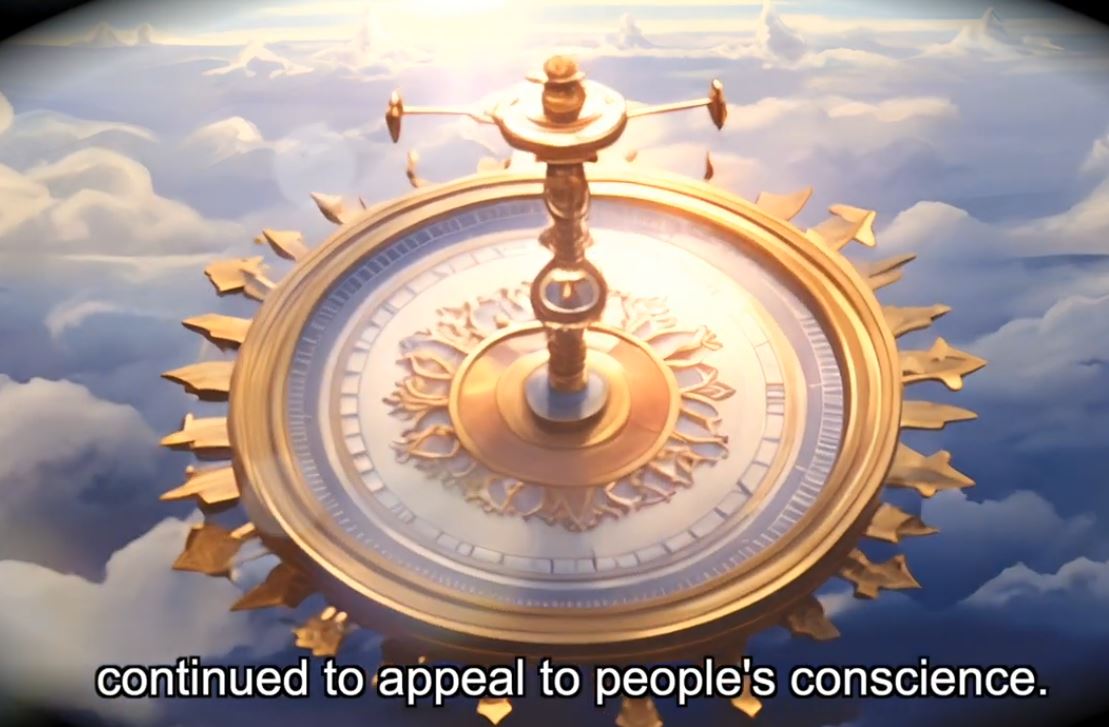
By juxtaposing the external pressures faced by Tai Ji Men with the film’s exploration of inner transformation, we are invited to adopt a dual lens for understanding conflict. On the one hand, systemic injustices—administrative overreach, legal misclassification, and the vulnerability of minority spiritual groups—must be confronted and corrected. On the other hand, sustainable peace requires the ethical work of cultivating conscience, a work that radiates outward into social and institutional life but begins within the individual.
With this framing, it is my pleasure to introduce “Children from Heaven”. The video offers an artistic expression of Tai Ji Men’s values and a conceptual bridge to the discussions that will follow. It reminds us that the study of religious conflict must attend to both structures of power and the moral imagination that shapes human action.
