
Why a fabricated assessment of taxes for the year 1992 has been void since the day it was issued.
by Massimo Introvigne
Article 1 of 2.
An article already published in Bitter Winter on November 16th, 2026.
Talk shows about tax law rarely compete with K-dramas for Sunday afternoon audiences. “Public Trial for All Citizens” (全民公審), an online program streamed every Sunday at 4 p.m. that promises to expose “the dark side of Taiwan’s law and taxation you never knew,” manages it by telling stories that sound more like crime thrillers than lectures on administrative procedure. Its October episode, now available on YouTube with English subtitles and English voice-over, focused on the Tai Ji Men case and offered one of the most detailed legal dissections Taiwanese viewers have heard in years.
The host, Emily, is a Tai Ji Men dizi (disciple) and a tax and legal reform activist. Her two guests were Jin Yi-zhen, a former general manager of Shang He Development and Construction Company, and Hsu Shu-hui, a Tai Ji Men dizi who introduced herself as a mother and a fellow reform activist. The studio conversation alternated with recorded contributions from scholars, a former Control Yuan member, and a tax officer who is no longer alive but whose words, preserved on video, sounded like testimony from beyond the grave.
Readers of “Bitter Winter” know the story’s outline. Tai Ji Men is a “menpai” (similar to a school) of Qigong, martial arts, and self-cultivation led by Dr. Hong Tao-Tze. In December 1996, during a crackdown on several religious and spiritual movements, prosecutor Hou Kuan-jen raided its academies, detained Dr. Hong and others, and accused them of fraud and tax evasion, claiming that the red envelopes disciples traditionally offer their master were the tuition fees of a lucrative “cram school.” On July 13, 2007, after ten years and seven months of trials, the Supreme Court acquitted all defendants and recognized the red envelopes as gifts, and the state later paid compensation to those Hou had detained.
The National Taxation Bureau (NTB), however, had issued income tax bills for the years 1991 to 1996 based on Hou’s indictment. Five of them were eventually corrected to zero after a 2018 Supreme Administrative Court decision. The 1992 bill survived on a technicality, and in 2020 it was used to seize, put up for auction, and nationalize land in Miaoli that Tai Ji Men regards as sacred.
The episode opened with a short video that took the survival of the 1992 bill apart piece by piece. It reminded viewers that the Ministry of Education stated as early as 1997 that Tai Ji Men is no cram school, that a public hearing repeated the point in 2000, and that the Ministry of Finance’s own review decisions of 2012 and 2013 agreed. The video compared the enforcement of the 1992 bill to dragging a death row inmate to the gallows after everybody has learned he was wrongly convicted. It also raised an issue of judicial recusal. Judge Huang Shu-ling handled the 1992 case at the Taichung High Administrative Court, where she conducted the preparatory proceedings and the taking of evidence. After a transfer to the Supreme Administrative Court, she ended up deciding the same case again. Since Taiwan’s highest courts decide on paper, without public hearings, Tai Ji Men never had a chance to ask for her recusal. “It’s like being stuck in a maze,” the narrator commented, “always the same group of people going round and round.”
Then came the questionnaire. During the administrative proceedings, the NTB mailed a survey to a sample of disciples asking about the nature of the red envelopes. All 206 who answered called them gifts. The NTB’s Taipei office reported that only nine had done so, and its Central Area office counted five. A later survey, announced after an Executive Yuan inter-ministerial meeting, collected 7,401 statements, all describing the red envelopes as gifts. At a Legislative Yuan public hearing on June 17, 2010, a Ministry of Finance official agreed on camera to escalate the matter, and a month later the Ministry informed legislators Tien Chiu-chin, Twu Shiing-jer, and Chou Shou-hsun that it had asked the Central Area NTB to withdraw enforcement. Sixteen years on, the Administrative Enforcement Agency’s Hsinchu branch has yet to stop. According to the video, on May 5 2020, the Taipei High Administrative Court also wrote to the Central Area NTB asking that the 1992 bill be treated like the other five years, meaning it should be corrected to zero.
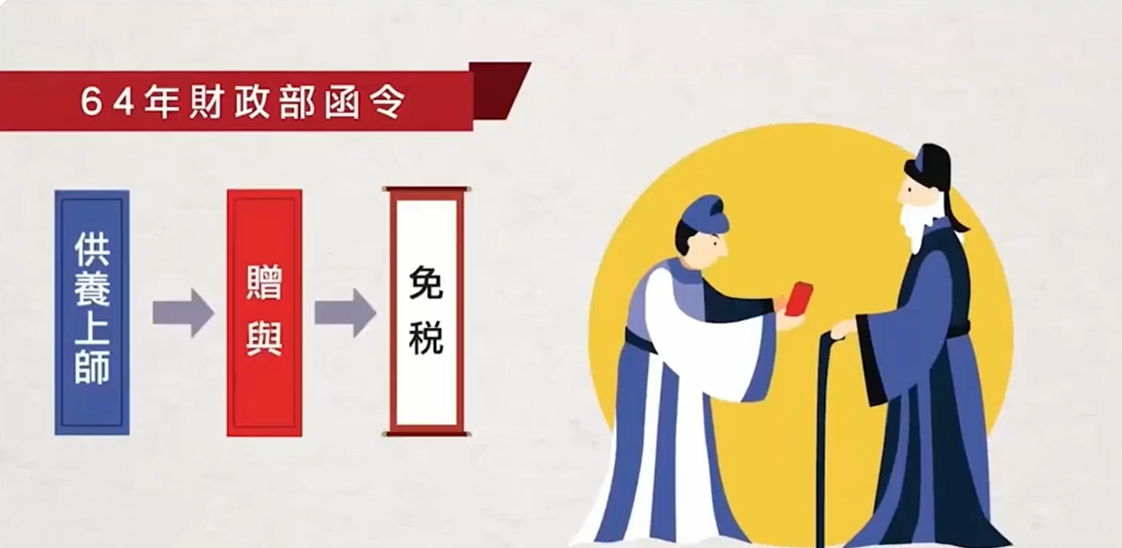
Emily summarized what the Control Yuan, Taiwan’s ombudsman body, found in its investigations: eight major violations committed by Hou Kuan-jen in its 2002 report, and seven by the NTB listed in a 2009 letter, for a total of fifteen. She then turned to her guests with the question that ran through the whole program. What happens to real people when the state issues a tax bill it should never have issued?
Jin Yi-zhen answered with a series of sentences that would fit a tax lawyer’s tombstone. “One tax bill can ruin a person’s name and reputation. One tax bill can bankrupt a family. One tax bill can tear a family apart and destroy lives.” The daughter of an elementary school principal and one of seven siblings, she grew up believing that making mistakes is acceptable and refusing to admit them is unforgivable, and only as an adult discovered that the tax administration followed the opposite rule. A tax dispute, she said, is like a mudslide: once caught in it, a taxpayer is swept along by fines, interest, enforcement, and endless procedures.
Her example was Huang Wen-huang, whom she called “the unluckiest pro bono lawyer in history.” Huang assisted a group of heirs free of charge, paid the costs himself, and was rewarded with a tax bill of 120 million New Taiwan dollars. When then-legislator Lu Shiow-yen asked how a volunteer lawyer could be penalized, then-Deputy Minister of Finance Chang Sheng-ford explained that officials feared Huang might collude with the heirs. Suspicion, in other words, was enough. Huang later confessed that the bill brought him to the edge of jumping from a building, and that one look at his sleeping child changed his mind and persuaded him to fight until his good name was restored.
Hsu Shu-hui told the story of Wu Pei-tsen, the director of a cram school whose owner was about to close it. With her students’ major exams approaching, Wu offered to take over the school. The sale never went through, but the NTB, unable to find the owner, sent her a bill for the school’s unpaid taxes of 1.59 million New Taiwan dollars, which grew to more than 3.2 million with interest and penalties. Wu won in court, and the NTB simply recalculated and repeatedly issued new bills. Hsu called them “illegal tax bills that never die,” a zombie category Taiwan’s tax code apparently knows well. Since 1997, Wu has suffered depression, two suicide attempts, a stay in a psychiatric ward, heart disease, diabetes, and breast cancer, and the NTB even seized her cancer insurance payout. Taxing the wrong person, Hsu said, repeating the word for emphasis, is “illegal, illegal.”